Upcoming Conference Dates:
Spring 2026
April 8 & 9 - in Wisconsin Dells, WI
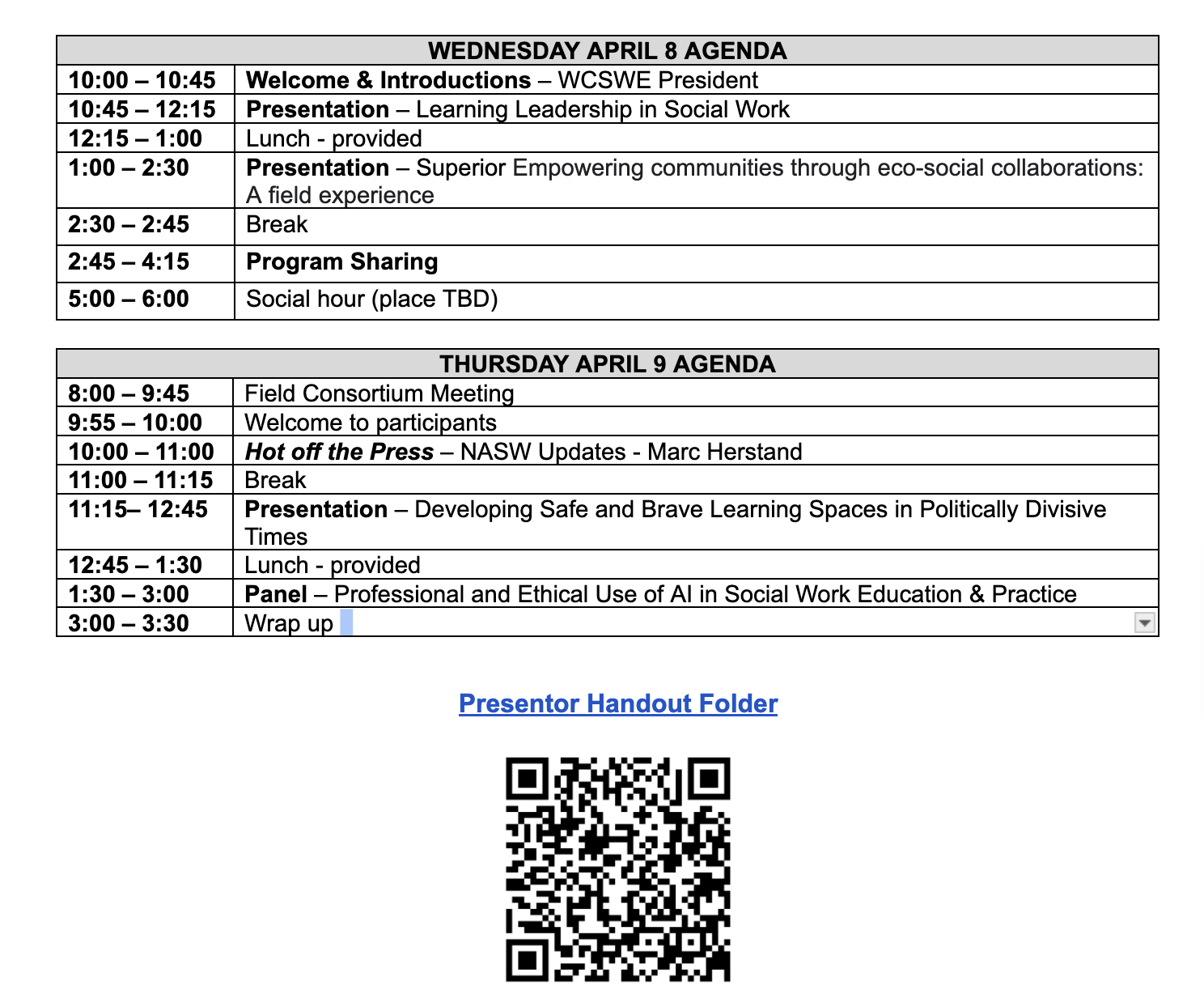
CONFERENCE HIGHLIGHTS
Presentation Title (1.5 CEH)
Learning Leadership in Social Work
Abstract
The presentation uses experience in leadership positions to question the preparedness of social work baccalaureate and master’s program graduates to lead through the challenges faced around the globe. Social work leaders may find themselves feeling powerless and without a voice. A review of the 2022 Council on Social Work Education’s Educational and Policy Accreditation Standards found that leadership is missing from the nine competencies of baccalaureate and master’s programs. These nine competencies are the foundation of social work education. The need for leadership is evident in the research; however, leadership in social work is not as widely studied as in other professions. The classroom may be the appropriate setting to prepare social work students to lead. There are creative collaborations linking academia and community organizations that try to help practicing social workers develop leadership skills. However, the time to engage in the programs is an issue for the practitioners volunteering for these leadership development programs. The lack of time to develop skills while practicing indicates that the classroom is the appropriate setting to teach social workers leadership. Adding leadership-specific language to the nine competencies of social work education could prepare social work students and new graduates with a leadership voice, empowering them to lead interdisciplinary teams and develop solutions through the challenges of the 21st century.
Learning Objectives
Understand two ways social work students are impacted by their education to lead change.
Identify three opportunities for the Council on Social Work Education (CSWE) to incorporate leadership into its competencies of social work education.
Identify one way to develop leadership in the classroom and the field.
Presenter(s)
R. Paul Perales II - University of Wisconsin - Oshkosh
Presentation Title (1.5 CEH)
Empowering communities through eco-social collaborations: A field experience
Abstract
The Social Work Department at the University of Wisconsin – River Falls began a partnership with the Kinnickinnic River Land Trust, a local environmental nonprofit, to examine barriers to outdoor spaces faced by many marginalized and oppressed groups. This culminated into a BSW-level field placement for the 2024-2025 academic year. One of the main projects of the field experience was to design and carry out a study examining the extent to which nature-based interventions decreased feelings of social isolation and loneliness in adults age 55+. Drawing on the existing literature we used a community-based participatory approach to gain ideas from the population of interest as to what kinds of nature-based activities they would like to do. We worked with participants and stakeholders in the community to design nature-based interventions that would be accessible to older participants, including those that may be living with physical and cognitive disabilities. In this workshop we will share our collaborative process and hopefully inspire other social work programs to infuse environmental justice into their educational experiences for students. Our session will use interactive scenarios (e.g., kayaking trip, birding hike, community garden, etc.) drawn from our research to engage participants in discussion and design of nature-based programs for populations with disabilities.
Learning Objectives
Understand the importance of nature to overall wellbeing, as well as barriers experienced by rural older adults.
Apply knowledge of the benefits of nature in creating nature-based interventions that are inclusive and accessible to rural older adults.
Create a learning opportunity for social work students that infuses the benefits of nature with eliminating barriers to outdoor spaces for marginalized and oppressed groups.
Presenter(s)
Shawyn Domyancich-Lee - University of Wisconsin -Superior
Presentation Title (1.5 CEH)
Panel: Professional and Ethical Use of AI in Social Work Education & Practice
Abstract
The use of artificial intelligence (AI) into social work practice and education presents opportunities and ethical challenges. This panel brings together social work educators to critically examine the ethical use of AI within social work education and professional practice, grounded in the NASW Code of Ethics. Panelists will explore emerging applications of AI in teaching, learning, research, and practice, while addressing concerns related to privacy, bias, equity, academic integrity, and professional competence. Through guided discussion and audience engagement, participants will be encouraged to reflect on their roles as educators in preparing students to use AI responsibly, ethically, and in ways that promote ecological and social justice, and client well-being.
Learning Objectives
Identify key ethical considerations related to the use of artificial intelligence in social work practice and social work education, including issues of bias, confidentiality, transparency, and equity.
Analyze how social work values and ethical standards can be applied to decision-making about AI use in teaching, learning, and professional practice.
Describe practical strategies for integrating ethical guidance on AI use into social work curricula and classroom policies to prepare students for responsible professional practice.
Panelists
Melinda Kiltz - Moderator - Mount Mary University
Colleen Galambos - Panelist - University of Wisconsin - Milwaukee
Joan Grossl - Panelist - University of Wisconsin - Green Bay
Amy Kirby - Panelist - University of Wisconsin - Milwaukee
Jessica Pac - Panelist - University of Wisconsin - Madison
Jen Schanen - Panelist - University of Wisconsin - Green Bay
Presentation Title (1.5 CEH)
Developing Safe and Brave Learning Spaces in Politically Divisive Times
Abstract
Social work educators are increasingly navigating challenging classroom conversations shaped by political polarization, media-driven narratives, and deeply held personal values. This session is designed for BSW and MSW faculty seeking ethically grounded, practical strategies for facilitating difficult discussions without shaming, silencing, or abandoning professional values. Grounded in the National Association of Social Workers Code of Ethics and aligned with Council on Social Work Education Educational Policy and Accreditation Standards, this workshop affirms the complexity of teaching in the current climate while offering clear tools faculty can use immediately.
Participants will explore the distinction between safe and brave learning spaces, examine ethical tensions—particularly between client self-determination and social justice—and engage in case-based vignettes drawn from real classroom scenarios. Through guided discussion and applied practice, faculty will develop language for managing and de-escalating difficult moments, strategies for setting expectations proactively in syllabi, and a values-based rationale for why these conversations are both necessary and ethically required in social work education.
Learning Objectives
Differentiate between safe and brave learning spaces in social work classrooms.
Apply the NASW Code of Ethics and CSWE EPAS to ethically complex classroom discussions.
Navigate tensions between self-determination and social justice using a case-based decision-making model.
Utilize practical language and strategies to manage and de-escalate challenging conversations.
Articulate an ethical justification for facilitating difficult discussions within social work curricula.
Presenter(s)
Jennifer Gervais - University of Utah
Sara Casali - University of Wisconsin - Milwaukee